
Hurricane Katrina, Race, and Class: Part I
I have been in Pensacola, Florida since late-Tuesday because my house in Mobile still is without electricity. I'm doing okay here, but I look forward to getting back home as soon as electricity is restored. The University is supposed to reopen on September 6th, but that may change, depending on conditions. Yesterday and today the gas stations here in Pensacola were mainly without gas, and I waited in a long line at the one station that (only briefly) had gas to offer. It's scary to see people begin to panic when basic commodities are in short supply; I can only imagine to what degree such a sense of panic must be magnified nearer to the epicenter, where essential necessities such as water, food, and sanitation are in severe shortage.
From my vantage — geographically and emotionally near the disaster, but safely buffered from its worst deprivations — much of the press coverage has not adequately dealt with the most difficult social issues that mark this still unfolding catastrophe. It is difficult to avoid concluding that one important cause of the slow response to the debacle has to do with the fact that most of the people who are caught up in it are poor and black. Here in Pensacola I keep hearing blame expressed towards the victims: "they should have heeded the call to evacuate." Even the FEMA chief said as much in a news conference today. So where, I must ask, were the busses he should have provided to take them away before Katrina hit? Where were the troops to supervise evacuation? Where were the emergency shelters and health services? People who ought to know better do not seem to understand or acknowledge the enormous differential in available resources — access to transportation, money, information, social services, etc. — that forms the background to this human catastrophe. Terms such as "looting" are tossed about in the press and on TV with no class or race analysis at all. In recent news reports, there is an emerging discussion of the political background to the calamity: the Bush administration's curtailment of federal funding for levee repair in order to pay for the war in Iraq, rampant commercial housing development on environmentally protective wetlands, financial evisceration of FEMA, and so on. But there's been little or no discussion of the economic background that makes New Orleans a kind of "Third World" nation unto itself, with fearsomely deteriorated housing projects, extraordinarily high crime and murder rates, and one of the worst public education systems in the country.
Major newspaper editors and TV producers have prepared very few reports about issues of race in this disaster, and those reports that have appeared so far seem to me deeply insufficient in their analysis of endemic class and race problems. I've been communicating with a national magazine reporter friend of mine since Tuesday night about the issues of race and class in this catastrophe; here's my email comment on this topic from earlier today:
CNN addressed the race question today on TV, but only to ask softball questions of Jesse Jackson, who to his discredit didn't exhibit even a modicum of the anger of one Louisiana black political leader, who said: "While the Administration has spoken of 'shock and awe' in the war on terror, the response to this disaster has been 'shockingly awful.'"
The Washington Post also ran a puff piece that doesn't ask any of the relevant questions, such as whether the Administration's response would have been faster if these were white people suffering the agonies of a slow motion disaster. Here's the link to the Post's piece.
Michael Moore also had this to say in a letter to President Bush circulated today:
No, Mr. Bush, you just stay the course. It's not your fault that 30 percent of New Orleans lives in poverty or that tens of thousands had no transportation to get out of town. C'mon, they're black! I mean, it's not like this happened to Kennebunkport. Can you imagine leaving white people on their roofs for five days? Don't make me laugh! Race has nothing — NOTHING — to do with this!
(See Michael Moore's full letter here.)
A member of the Congressional Black Caucus had to remind reporters today to stop referring to those displaced by the flooding with the blanket term "refugees" (recalling, of course, the waves of Haitian or Central American or Southeast Asian refugees who sought shelter in the US): these people are citizens, she said, deserving of the full protections guaranteed to all Americans.
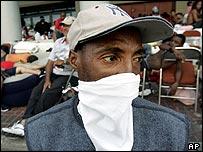
The federal government promised on Wednesday that those receiving food stamps could get their full allotment at the beginning of September, rather than the usual piecemeal distribution throughout the month. How very generous. What these people need is relief money and access to services now — even the 50,000 or so exhausted and traumatized people whose images we've seen at the N.O. Superdome and at the Civic Center are just a few of the far larger number of those residents of the region displaced by the hurricane, many of whom live from monthly paycheck to paycheck. It will be months at the very least before these people can return home; their jobs may be gone for good. The mayor of New Orleans was actually caught off camera crying in frustration today at the slow pace of the federal response.
If there is a hopeful side to this tragedy, it is perhaps that Hurricane Katrina's damage and efforts to relieve those displaced by the storm may spark a wider national discussion about the ongoing and unaddressed issues of race and economic disparity in America. If that doesn't happen, I fear that there will be even further deterioration in the living conditions and economic predicament of those left destitute and homeless by Katrina — a situation in which our own government's years of neglect must be included as a crucial contributing factor. We must not let such a deterioration of conditions for those hardest hit by Katrina occur.
What happens next, when tens or hundreds of thousands of Americans require long-term recovery help, will be an important barometer of our society's ability to heal itself.
—Lincoln
posted by Lincoln Z. Shlensky @ 4:00 PM


3 Comments:
How many copters do you think you can fly around the city at the same time? You are focusing your anger on the wrong people. The people of N.O. helped elect the governor and they got what they elected. SHE had control over the evacuation and the initial rescue efforts. The state has access to hundreds if not thousands of busses, but Blanco could not decide what to do or where to send the people. FEMA initially had no reason to send food to people the governor said she was going to evacuate! They sent the food to the shelters. And then the "hoodlums" started shooting their own city up hampering the rescue efforts greatly. White people don't do that. That's not FEMA's fault, either. When you encourage a dependent society for your own political purposes, it comes back to bite you in a crisis. It is absolutely ridiculous to suggest that this is the fault of the federal government or that it has anything to do with race!
I don't believe this has a THING to do with race. I am employed by one of the radio stations in town that has been doing 24 hour coverage and information, so I have been glued to the fax machine and the TV for the past four days. I DO believe that the response to the disaster was not quick enough and perhaps could have been much more efficient had we not had our entire military resource exhausted in Iraq. However, I think we have to keep in mind that it was very difficult, and to an extent still is, to access the New Orleans area. The relief effort in Biloxi was much stronger, partially because the city was easier to reach and partially because the preparations, I believe, were slightly better in that area. I also agree with the prior comment that the shootings and debauchery of the evacuees greatly hindered the process. The Red Cross, at one point, said they would not provide anymore help until security was increased after one of their volunteers was shot in the leg. That kind of behavior is absolutely ridiculous. I feel bad for the people in New Orleans. I genuinely do. I am doing as much to aid the relief effort as I am financially and physically able to do, as well as informing the public on a daily basis via the radio station. But by the same token, I believe the effort in New Orleans is moving as well as possible and CERTAINLY has nothing to do with the race or class status of the people who have been trapped. I'm so tired of the Bush-bashing bullshit (scuze the language). I've heard Kanye West (a rapper) say "Bush doesn't care about black people". People are just trying to find ways to bash the President and using this as an excuse to do so. While I don't agree with many of his policies, this is not entirely his fault, and certainly has no racial implications.
Also, not to throw a cold shoulder towards the situation, but these people were TOLD to leave. Not just by their mayor, not even just by their governor, but by the President of the United States. If the frickin President tells you to do something, it must be a pretty serious ordeal. Granted, not all of the citizens could afford to leave town, but they were offered the option to and encouraged to take the bus to the Superdome (which although it may not be the most plush circumstances, was a relatively safe shelter). Although I sympathize with those people who chose not to do so, they had to know their fate was a real possibility considering the circumstances and geography of the area they were residing in.
Also, apparently President Bush apparently told Louisiana Governor Blanco to declare martial law BEFORE the hurricane so that he could have the national guard come in and help with the evacuation. There is no way he could have done so without her permission BEFORE the disaster. She "had to think about it for 24 hours". Had to think about it?? Much more could have been done to prevent this situation had she not taken this foolish and stubborn approach. I know somebody who won't be re-elected for another term.
And no, its not because she's white.
Post a Comment
<< Home